Current Topics
College Planning in "What If?" Times
Marla Platt, MBA • May 5, 2020

This time of Covid has brought each of us a slew of uninvited challenges.
Business as usual no longer has meaning because there is no ‘usual.’ Improvisation and guesswork have now become the drivers behind planning and direction. But because solid planning is forged on educated experience — and no one living today has experienced anything like the environment we are currently living in — our planning needs to emerge through ‘what-if?’ scenarios, followed by the ‘what thens?’
So what if
I am a rising high school senior
and unable to physically visit colleges I am seriously interested in? What if
I am unable to re-take the SAT or ACT?
What do I do if
I was planning on ED or EA applications
to the colleges that still require standardized testing scores? What if
my parent lost her job and college affordability
has become an increasingly looming question? What if
my style of learning
does not jibe well with an online classroom?
Still, even difficult-to-answer questions deserve thoughtful answers. Be in touch
if I can support your college process with clarity and calm
to diminish the confusion that comes with confusing times. I will do my best to share with you what I am learning -- and avoid the guesswork.
Marla Platt, M.B.A. is an independent college consultant based in Sudbury, MA through AchieveCoach College Consulting, providing expert and personalized college counseling to students and families throughout the college planning, search and admissions process. Marla is a professional member of the Independent Educational Consultants Association and can be reached via www.achievecoach.com
Serving high school students in:
Sudbury, Wayland, Acton, Groton, Hopkinton, Newton, Wellesley, Weston, Natick, Needham, Brookline, Bolton, Concord, Carlisle, Lexington, Framingham, Dover, Sherborn, Grafton, Hopkinton, Arlington, Cambridge and all of Metrowest Boston and New England.
Recent posts

What makes a high school passion project meaningful to selective college admissions, and how to help your student build one that lasts.

When choosing a college, campus mental health resources matter as much as academics. Learn what to look for, what to ask, and which schools earned the 2026 Princeton Review Mental Health Services Honor Roll.

The ACT Science section is now optional at most colleges. Find out exactly who requires it, who recommends it, and how to decide if it's right for your college list.

Colleges with rolling admissions review your application as it arrives — no waiting for a deadline. Discover the top schools and how to apply strategically.

What do colleges really look for in applications? A college consultant explains what matters most—from grades to activities to personal fit.
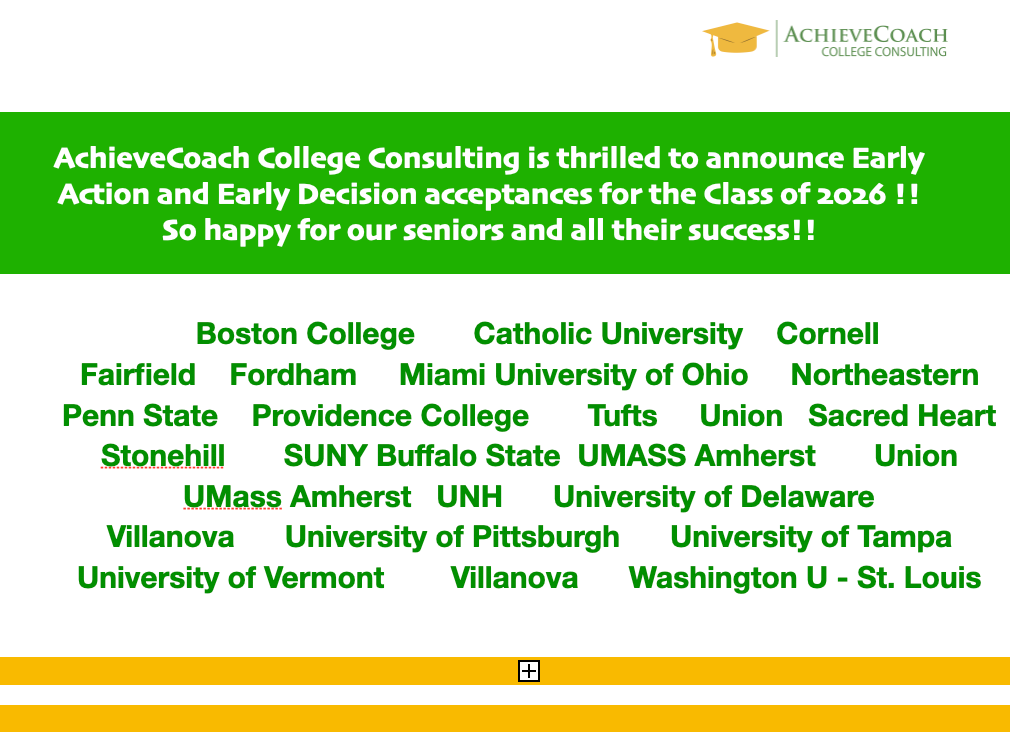
ADMISSIONS ACHIEVED!! Here are some of the colleges our students have been admitted to